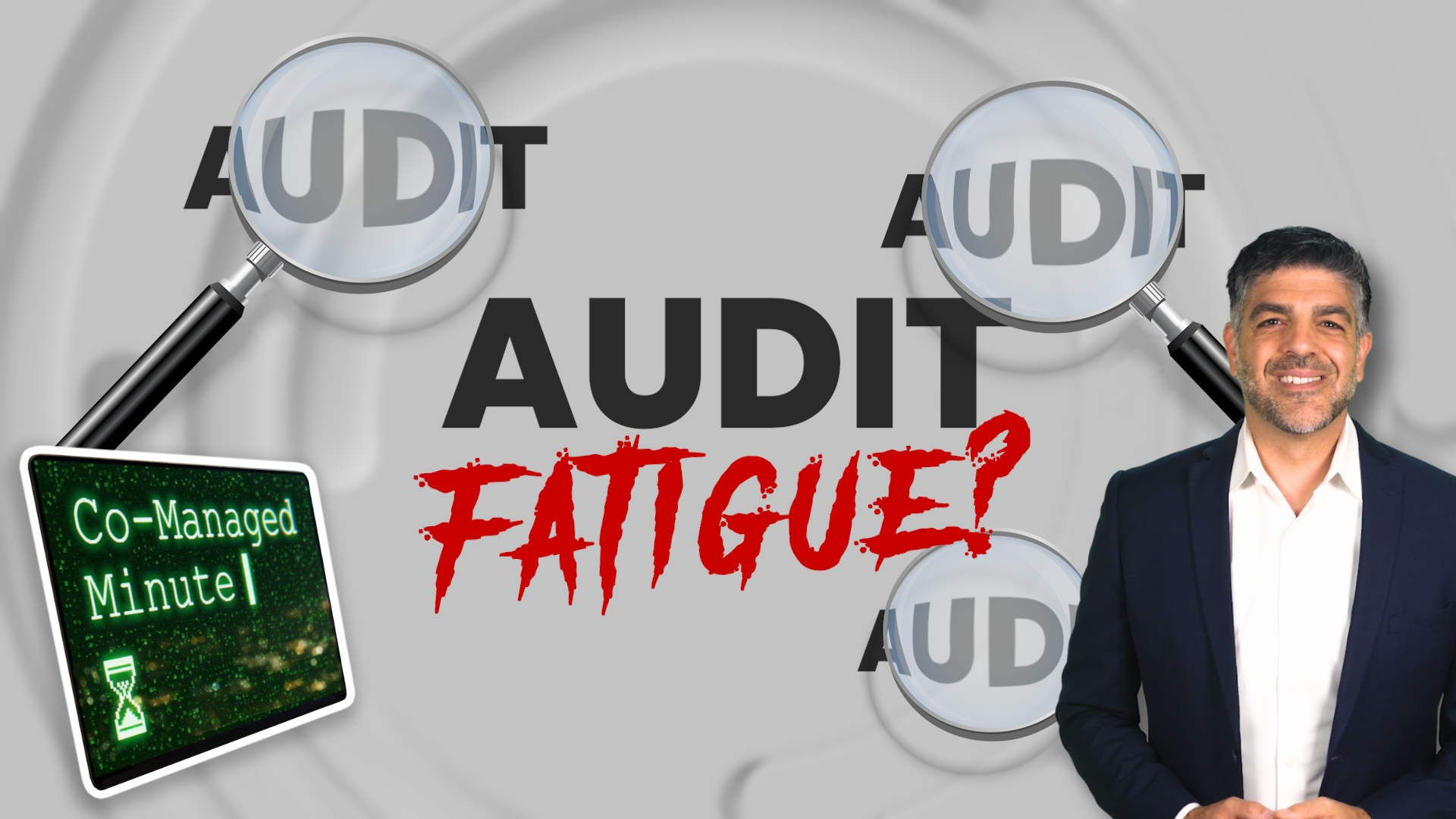
You probably don’t think of audits as a major problem.
They’re part of the job.
Security reviews, compliance checks, certifications, internal assessments… they’re there to reduce risk and provide assurance to the business.
But they keep coming back.
Just as one cycle finishes, another begins.
Evidence needs updating, documentation needs reviewing, and of course, all of the controls need validating again.
The same questions get asked in slightly different ways.
Over time it adds up.
Each audit on its own is manageable, but together, they start to take up a huge amount of your time and attention.
The challenge is fitting it all in alongside everything else.
Projects still need to move forward. Support demand doesn’t slow down. Security work continues. Planning still needs to happen.
Audit activity sits across all of that, often pulling focus away from work that would reduce risk more directly.
There’s also a familiarity to it.
Much of the work involves gathering evidence that already exists, reformatting information, or revisiting documentation that hasn’t materially changed. It’s necessary, but it can feel repetitive.
When that pressure builds, audits can become reactive.
Preparation starts later than you’d like. Evidence is pulled together quickly. Documentation gets updated just in time.
The outcome might still be successful, but it requires more effort than it should.
What tends to make the biggest difference is structure.
Keeping documentation current as part of normal operations. Maintaining evidence in a way that’s easy to access. Treating audit readiness as something continuous rather than something that happens in cycles.
You already know this.
The difficulty is maintaining that level of organization while managing day-to-day demands.
This is where co-managed support can help in a practical way.
It doesn’t take ownership of compliance, or step into your role. It supports the work that sits behind it.
That might mean helping keep documentation up to date, maintaining evidence trails, or supporting audit preparation so it doesn’t all land at once.
You still own the standards and define what good looks like.
The difference is that audits become less disruptive.
Instead of pulling you away from everything else, they become something that fits more naturally into how the environment is already managed.
Audit requirements aren’t going away. If anything, they’re becoming more frequent and more detailed.
But will they continue to interrupt your team’s focus? Or will they become part of a steady, manageable rhythm?
If audit cycles are starting to feel heavier than they should, let’s talk about how we can help. Get in touch.